Ness City Computer Service LLC

Home › Blog › Security
Security

Is Your Browser Hijacked? Signs, Causes and How to Fix It

By Chris Harrison · October 8, 2026 · 6 min read

A browser hijack is when something changes how your web browser behaves without you meaning it to. It’s rarely as dramatic as it sounds, but it’s annoying, it exposes you to scams, and it can slow your computer down.

Signs your browser has been hijacked

  • Pop-up notifications in the corner of your screen with “virus found,” prize or “subscription expired” messages — even when the browser is closed
  • Your homepage or search engine changed to something you’ve never heard of
  • Searches are sent through an unfamiliar site before showing results
  • New toolbars, buttons or extensions you didn’t install
  • Links that open random pages, or new tabs that open by themselves

The “click Allow” trick

One of the most common causes is a website that asks for permission to send you notifications — disguised as a robot check or a video player.
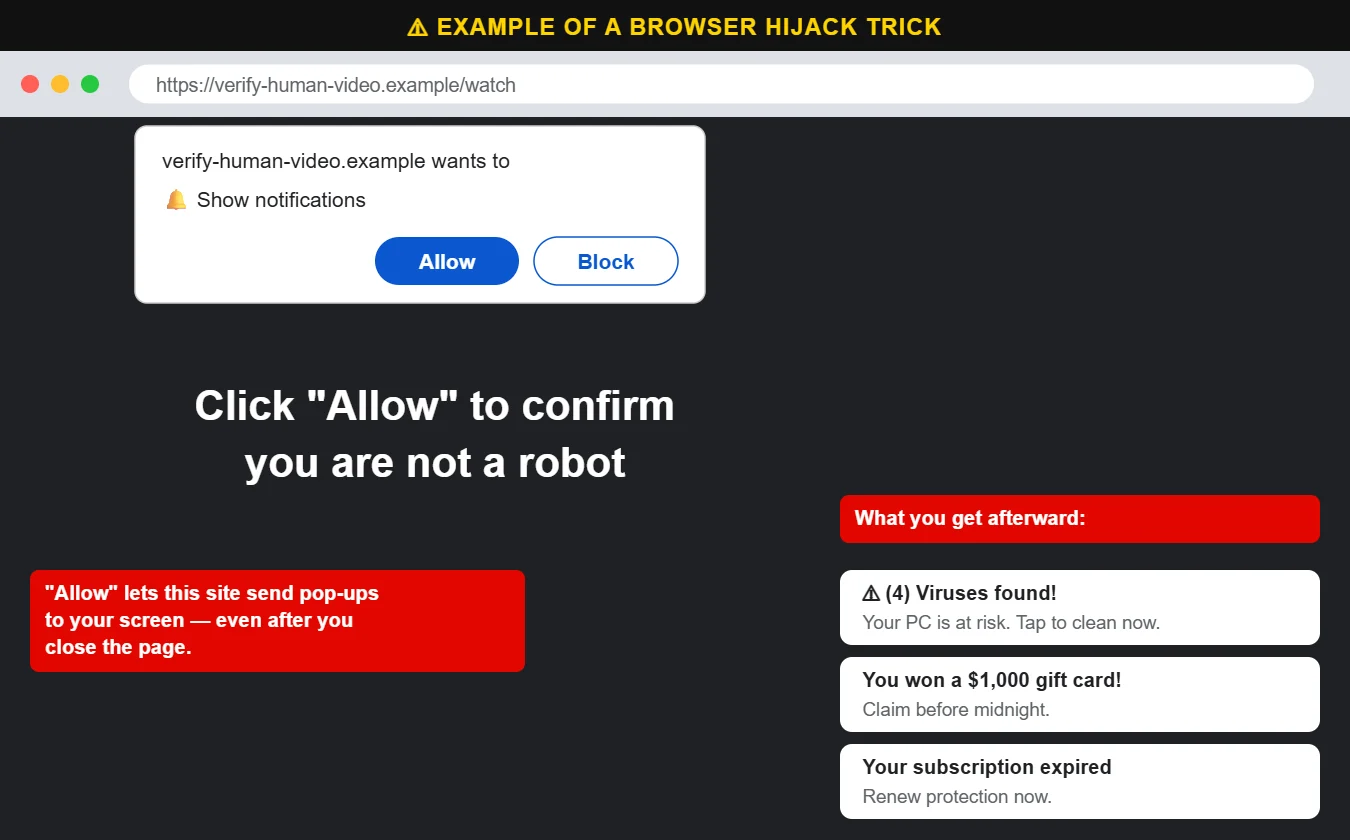
Example of a website tricking users into allowing browser notifications
Clicking “Allow” doesn’t prove you’re human. It gives the site permission to push ads and fake warnings to your screen.

Our rule: always click “Block” when a website asks to show notifications.

Almost no website you visit actually needs to send you notifications. Saying yes is one of the most common ways scareware, fake virus alerts and browser hijackers get onto computers and phones. If you’re not sure, choose Block (or Don’t Allow) — you can always change it later.

Once you click Allow, that site can send notifications to your desktop or phone whenever it likes. Many of them link straight to scareware pages or shady downloads.

Going forward, make “Block” your default answer. You can even turn off notification requests entirely: in Chrome, go to Site settings → Notifications and choose “Don’t allow sites to send notifications.” Edge and Firefox have similar options.

Other common causes

  • Bundled software. Free programs from download sites often include “optional offers” that install toolbars or change your search engine. Read every installer screen and choose “Custom” install when offered.
  • Malicious or abandoned extensions. An extension can be sold to a new owner and quietly updated to inject ads or track you.
  • Fake “browser update” or “video player” downloads from pop-ups.

How to fix it

1. Remove notification permissions

  • Chrome: Settings → Privacy and security → Site settings → Notifications. Remove any site you don’t recognize from the “Allowed” list.
  • Edge: Settings → Cookies and site permissions → Notifications.
  • Firefox: Settings → Privacy & Security → Permissions → Notifications → Settings.
  • Android: Chrome → Settings → Site settings → Notifications. You can also long-press a spam notification and turn it off.
  • iPhone and iPad: websites can only send notifications if they were added to your Home Screen. Check Settings → Notifications for any web apps you don’t recognize and turn them off.

2. Remove extensions you don’t use or recognize

Open your browser’s Extensions or Add-ons page and remove anything you didn’t deliberately install. Fewer extensions is safer.

3. Reset your browser settings

Chrome and Edge both have a “Reset settings” option that restores the default homepage and search engine and turns off extensions without deleting your bookmarks or saved passwords.

4. Check installed programs

On Windows, open Settings → Apps → Installed apps and sort by install date. Uninstall anything suspicious that appeared around the time the problems started.

5. Run a security scan

Run a full scan with your antivirus to catch anything left behind.

When to call for help

If the changes keep coming back after you reset them, something on the computer is reinstalling them. That’s a good time to let us take a look. Call us at 620-960-8711 — we can usually clean this up remotely the same day. For businesses, our managed cybersecurity blocks many of these sites before anyone can click “Allow.”

Want more free guides like this? Browse our Scam & Security Library — real examples of phishing emails, scam texts, fake pop-ups and more.

Chris Harrison, owner of Ness City Computer Service
About the author
Chris Harrison

Chris owns Ness City Computer Service and has more than 30 years of IT experience helping Kansas homes and businesses keep their technology running and secure.

Have a question about your tech?

Call the local guys. We’re happy to help — no pressure.

Services

How we can help

Computer repair & PC sales

Managed IT services

Cybersecurity

Networking & Wi-Fi

Backup & disaster recovery

VoIP business phones

Surveillance & alarms

Web design & hosting

Scroll to Top
