
Ness City Computer Service LLC

Home › Blog › Security
Security

"Your Browser Is Out of Date": Fake Update Pop-Ups That Install Malware

By Chris Harrison · October 8, 2026 · 4 min read

You open a news story or a local business website and the page goes gray. A box appears: “Your browser is out of date. Update now to view this page.” There’s a big blue button and a small file ready to download.

It looks helpful. It’s actually one of the most common ways criminals install password-stealing malware today — often on legitimate websites that have been hacked.
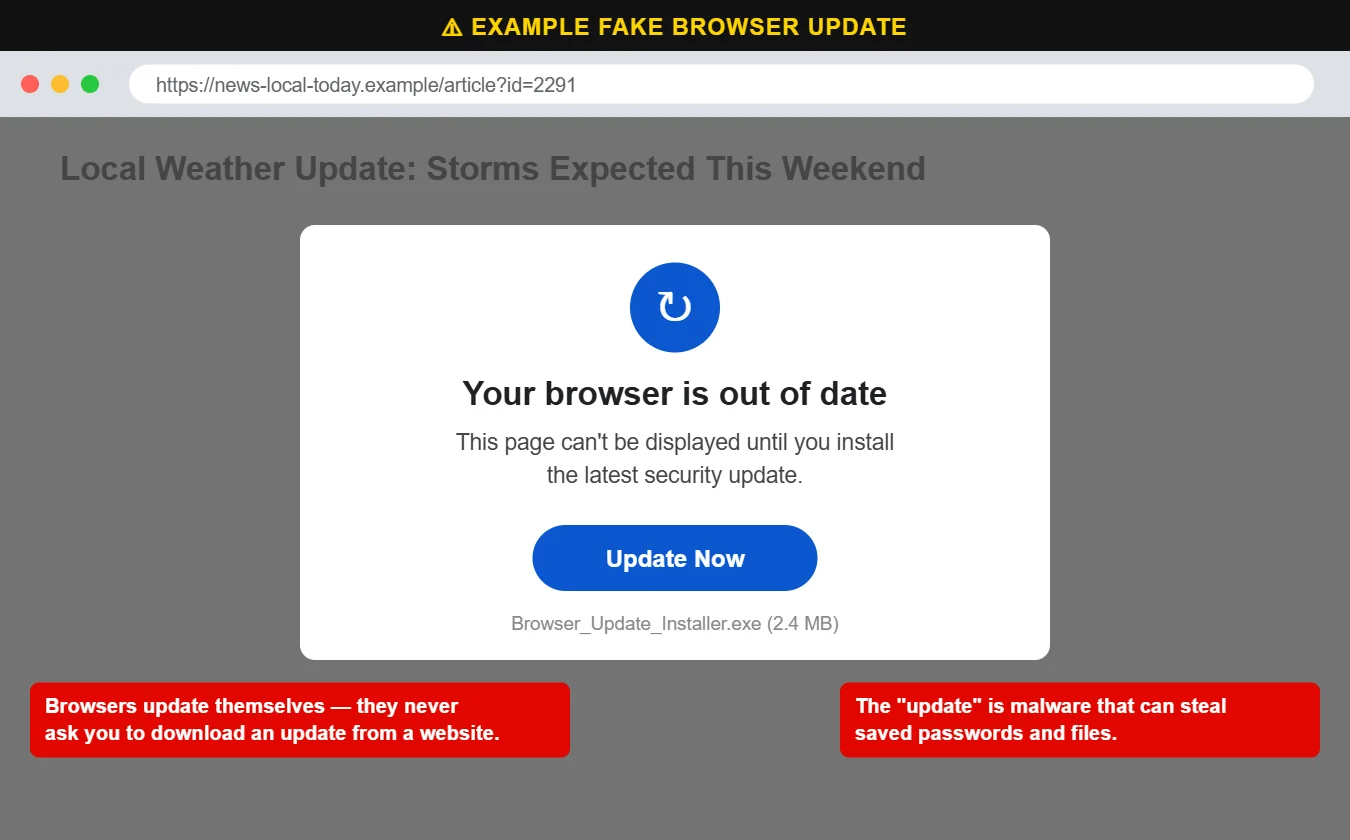
Example of a fake browser update pop-up on a website
A fake “update” pop-up on a hacked website. Real browsers never ask you to download updates this way.

How real browser updates work

Chrome, Edge, Firefox and Safari update themselves in the background. At most, you’ll see a small “Update” or “Relaunch” button in the browser’s own toolbar or settings menu — never a pop-up inside a web page asking you to download a file.

Red flags

  • The “update” message appears inside the web page, not in the browser’s toolbar or settings.
  • It asks you to download and run a file (often ending in .exe, .msi, .zip or .js).
  • It claims the page won’t load until you update.
  • You get similar prompts to update “video players,” “fonts” or “codecs.”

What to do

  • Close the tab. Don’t click the button.
  • To check for a real update, open your browser’s menu and go to Help → About (Chrome, Edge, Firefox) — it will check and update on its own.
  • Keep Windows and macOS set to update automatically.

If you already downloaded and ran it

  1. Disconnect the computer from the internet.
  2. From a different device, change passwords for email, banking and any accounts saved in your browser.
  3. Have the computer checked and cleaned. This type of malware is designed to steal saved passwords and browser sessions quickly.

Call us at 620-960-8711 — we can tell you quickly whether a file is safe. For businesses, managed cybersecurity blocks many of these downloads before they run.

Want more free guides like this? Browse our Scam & Security Library — real examples of phishing emails, scam texts, fake pop-ups and more.

Chris Harrison, owner of Ness City Computer Service
About the author
Chris Harrison

Chris owns Ness City Computer Service and has more than 30 years of IT experience helping Kansas homes and businesses keep their technology running and secure.

Have a question about your tech?

Call the local guys. We’re happy to help — no pressure.

Services

How we can help

Computer repair & PC sales

Managed IT services

Cybersecurity

Networking & Wi-Fi

Backup & disaster recovery

VoIP business phones

Surveillance & alarms

Web design & hosting

Scroll to Top
